Digital Hitaksh Shinde – A Certified Digital Marketer in Dahisar Mumbai

Uncategorized

Local SEO Checklist for Indian Businesses: The Complete Guide to Rank Higher Locally

By Digital Hitakshi Shinde | Digital Marketing Blogger Primary Keyword: Local SEO Checklist for Indian Businesses Secondary Keywords: local SEO for Indian businesses, local SEO checklist, local SEO India, Google Business Profile SEO, local search optimization, local SEO tips, local SEO strategy, Google Maps SEO, local business SEO Suggested SEO Title: Local SEO Checklist for Indian Businesses: Complete 2026 Guide Meta Description: Follow this complete Local SEO checklist for Indian businesses to improve Google Maps visibility, attract nearby customers, optimize your Google Business Profile, and generate more local leads. Suggested URL Slug: /local-seo-checklist-for-indian-businesses/ Introduction If you own a business in India, being visible when potential customers search for your products or services locally can make a significant difference. Think about searches such as: These are local-intent searches. The person searching isn’t simply looking for information—they may be looking for a business they can call, visit, message, or buy from. This is where local SEO becomes important. Local SEO helps businesses improve their visibility in geographically relevant searches across Google Search and Google Maps. Google’s own guidance says local results are primarily influenced by relevance, distance, and prominence. Complete and accurate Business Profile information can help Google better understand whether a business is relevant to a customer’s search. For Indian businesses, local SEO can be particularly useful because customers often search using combinations of service + location, neighbourhood names, “near me” phrases, and local-language or mixed-language queries. In this guide, I’ll share a practical Local SEO checklist for Indian businesses that you can use to improve your local online presence. What Is Local SEO? Local SEO (Search Engine Optimization) is the process of improving a business’s online presence so it can become more visible for searches connected to a specific geographic area. For example, a bakery in Andheri, Mumbai may want to appear when someone searches: “bakery in Andheri” or: “cake shop near me.” Local SEO can involve: Local SEO is not simply about adding a city name to every page. It is about helping both search engines and customers understand what your business does, where it operates, and why they should choose you. Why Local SEO Matters for Indian Businesses Imagine two businesses offering the same service. Business A has: Business B has: Which business looks more trustworthy to a potential customer? The second business has created a much stronger local digital presence. Google says businesses with complete and accurate information are more likely to appear in relevant local searches, while factors such as reviews and prominence also contribute to local ranking. For local businesses, visibility can translate into: Local SEO Checklist for Indian Businesses Use the following checklist as a practical starting point. 1. Create or Claim Your Google Business Profile Your first priority should be establishing your Google Business Profile if your business is eligible. A verified Business Profile can help customers discover your business through Google Search and Maps. Google provides the option to add or claim a profile at no charge. Make sure your profile includes accurate: Checklist: ☐ Profile claimed☐ Business verified☐ Correct business category☐ Correct address/service area☐ Correct phone number☐ Website added☐ Opening hours updated☐ Services/products added☐ Photos uploaded 2. Choose the Right Primary Business Category Your Google Business Profile category helps communicate what your business actually does. Don’t select a category simply because you think it has a high search volume. Choose the category that most accurately represents your core business. For example, if you operate a digital marketing agency, your primary category should reflect your main business rather than adding unrelated categories just to target additional keywords. Google’s guidelines recommend choosing the fewest categories necessary to describe the overall core business accurately. 3. Keep Your Business Information Consistent One of the most important local SEO tasks is maintaining consistent business information across the web. Pay attention to: Name + Address + Phone Number (NAP) Your information should be accurate and consistent across relevant platforms. For example, avoid having: ABC Digital Solutions on one website and: ABC Digital Solution Pvt. Ltd. on another if they represent the same business but aren’t being used consistently. Check your information across: Consistency makes your online presence clearer to users and search engines. 4. Optimize Your Website for Local Keywords Keyword research remains an important part of local SEO. Instead of targeting only broad keywords such as: “digital marketing agency” consider location-specific searches such as: However, avoid unnatural keyword stuffing. Write for humans first. A good local landing page might naturally include: 5. Create Useful Location Pages If your business genuinely serves multiple locations, location pages can help communicate that clearly. For example, an agency serving several cities could have pages such as: Digital Marketing Services in Mumbai Digital Marketing Services in Pune Digital Marketing Services in Bangalore But there is an important warning: Don’t create dozens of nearly identical pages simply by changing the city name. Each location page should provide genuinely useful information about that market. Include: The objective should be usefulness, not keyword multiplication. 6. Add Your Complete Contact Information Your website should make it extremely easy for a local customer to contact you. Include: Consider adding a clear Call Now, Book Appointment, Get Directions, or WhatsApp Us call-to-action depending on your business model. Local SEO should ultimately support business outcomes—not just rankings. 7. Optimize Your Google Business Profile Description Your Business Profile description should clearly explain: Avoid stuffing the description with repetitive city names or keywords. Your description should sound natural and accurately represent your business. Google’s guidelines require businesses to represent themselves accurately on their profiles. 8. Add High-Quality Photos and Videos Visual content can make a local business profile much more convincing. Depending on your business, add: For example, a restaurant can showcase dishes and its dining environment. A salon can show its interiors and work. A digital marketing agency can showcase its team, workspace, client work, or educational events. Google specifically recommends adding photos and videos to help businesses showcase what they offer. 9. Build a Genuine Review Strategy

Local SEO Checklist for Indian Businesses: The Complete Guide to Rank Higher Locally Read More »

Content Marketing vs Social Media Marketing: What’s the Difference and Which Is Better?

By Digital Hitakshi Shinde | Digital Marketing Blogger Primary Keyword: Content Marketing vs Social Media MarketingSecondary Keywords: content marketing, social media marketing, content marketing vs social media marketing difference, content marketing strategy, social media marketing strategy, content vs social media marketing, digital marketing Suggested SEO Title: Content Marketing vs Social Media Marketing: Key Differences & Which Is Better? Meta Description: Content Marketing vs Social Media Marketing explained. Learn the key differences, benefits, strategies, costs, and how to choose the right approach for your business. Suggested URL Slug: /content-marketing-vs-social-media-marketing/ Introduction Digital marketing gives businesses countless ways to reach potential customers. Two of the most popular approaches are content marketing and social media marketing. But what exactly is the difference between them? Many beginners use the terms interchangeably because both involve creating and distributing content online. However, their objectives, platforms, strategies, and measurement methods can be quite different. Content marketing focuses primarily on creating and distributing valuable, relevant content to attract and educate a specific audience. Social media marketing focuses on using social platforms to build awareness, engage communities, distribute content, generate leads, and drive business results. So, when it comes to content marketing vs social media marketing, which one should a business choose? The answer is usually not one or the other. A strong digital marketing strategy often combines both. In this guide, we’ll explore the differences between content marketing and social media marketing, their advantages and disadvantages, costs, SEO impact, examples, and how businesses can use both strategies together. What Is Content Marketing? Content marketing is a strategic marketing approach based on creating and distributing useful, relevant, and valuable content for a clearly defined audience. Instead of directly asking someone to buy a product or service, content marketing aims to answer questions, solve problems, educate readers, demonstrate expertise, and gradually build trust. Content can take many forms, including: For example, a digital marketing agency might publish an article titled: “How to Improve Your Website’s Google Rankings” The article may not immediately sell an SEO service. Instead, it provides useful information to people who are already interested in SEO. Over time, that reader may subscribe to the company’s newsletter, explore its services, or become a customer. This is one of the biggest strengths of content marketing: it can attract people before they are ready to buy. What Is Social Media Marketing? Social media marketing is the process of using social media platforms to promote a brand, communicate with audiences, distribute content, build communities, and achieve marketing objectives. Popular social platforms include: Social media marketing can involve both organic and paid activities. Examples include: For example, a digital marketing blogger could turn a long-form SEO article into a short Instagram carousel explaining: “5 SEO Mistakes Beginners Should Avoid.” The social post can attract attention and encourage users to visit the full article. This demonstrates how social media can work as a distribution and engagement channel for content marketing. Content Marketing vs Social Media Marketing: Key Differences Although both strategies use content, they are not identical. Factor Content Marketing Social Media Marketing Main purpose Educate, attract & build trust Engage, distribute & build community Primary platforms Website, blog, email, YouTube, etc. Social media platforms Content lifespan Often longer Often shorter and trend-driven SEO impact Strong Usually indirect Audience relationship Often deeper over time Fast interaction and engagement Main assets Blogs, guides, videos, case studies Posts, reels, stories, videos Discovery Search engines and referrals Social feeds and communities Measurement Traffic, rankings, leads, conversions Reach, engagement, followers, clicks Best for Long-term authority Awareness and engagement Strategy Evergreen + educational Platform-specific + conversational The biggest distinction is simple: Content marketing is primarily about the value of the content. Social media marketing is primarily about using social platforms to distribute, promote, and engage around content and brand messages. Content Marketing vs Social Media Marketing: Which Is Better for SEO? If your primary objective is organic search visibility, content marketing generally has a stronger direct relationship with SEO. A well-optimized website can attract search traffic through: For example, if you publish a comprehensive article targeting “content marketing vs social media marketing,” the page can potentially attract users searching for that topic. Social media can still contribute to your overall digital presence, but social engagement itself should not be treated as a substitute for an SEO strategy. This is why businesses that want sustainable organic traffic often invest in a combination of: SEO + content marketing + social media distribution. Benefits of Content Marketing 1. Builds Long-Term Organic Traffic One of the biggest advantages of content marketing is that a useful article can continue attracting visitors long after publication. A social post may receive most of its attention within a relatively short period, while a strong evergreen article can continue generating search impressions and clicks over time. 2. Establishes Authority Consistently publishing genuinely useful content can demonstrate expertise in a specific subject. For example, a marketing website publishing detailed resources about: can gradually establish topical authority. 3. Supports the Customer Journey Content can target different stages of the buying journey. Awareness:“What is SEO?” Consideration:“SEO vs PPC: Which is better?” Decision:“Best SEO agency for small businesses” This makes content marketing useful throughout the funnel. 4. Supports SEO Content gives search engines more relevant pages to understand and potentially rank. When content matches search intent and provides genuine value, it can become an important part of an organic growth strategy. 5. Can Generate Leads A blog post can direct readers toward: Therefore, content marketing doesn’t have to stop at traffic. It can support conversions as well. Benefits of Social Media Marketing 1. Builds Brand Awareness Social platforms allow businesses to put their brand in front of large audiences. A strong Reel, YouTube Short, LinkedIn post, or carousel can introduce a brand to people who have never visited its website. 2. Creates Direct Engagement Social media is highly interactive. Customers can: This creates opportunities for businesses to understand their audiences more closely. 3. Fast Content Distribution Have you published a new

Content Marketing vs Social Media Marketing: What’s the Difference and Which Is Better? Read More »

Best AI Tools for Digital Marketers in 2026: Top Tools to Create, Optimize & Scale Your Marketing

By Digital Hitakshi Shinde | Digital Marketing Blogger Meta Title: Best AI Tools for Digital Marketers in 2026 | Digital HitakshiMeta Description: Discover the best AI tools for digital marketers in 2026 for SEO, content creation, social media, ads, analytics, research, and marketing automation.Suggested URL Slug: /best-ai-tools-for-digital-marketers/Primary Keyword: best AI tools for digital marketersSecondary Keywords: AI marketing tools, AI tools for digital marketing, AI tools for marketers, best AI tools 2026, AI tools for SEO, AI content marketing tools Introduction: Why AI Tools Matter for Digital Marketers in 2026 Digital marketing is changing faster than ever. Marketers are expected to create more content, understand customer behaviour, manage social media, analyze campaign performance, optimize websites, and generate measurable results—all while working with limited time and resources. This is where AI tools for digital marketing can make a major difference. Artificial intelligence is no longer simply a tool for generating blog ideas or writing social media captions. Modern AI platforms can support marketers across research, content creation, SEO, advertising, analytics, customer engagement, personalization, and automation. Google is also increasingly positioning AI as part of the modern marketing workflow. At Google Marketing Live 2026, Google highlighted Gemini-powered capabilities designed to support discovery, creativity, commerce, and measurement, particularly for businesses operating across Search and YouTube. However, using AI effectively does not mean handing your entire marketing strategy over to machines. The best results come from combining AI speed with human strategy, creativity, expertise, and fact-checking. This guide explores some of the best AI tools for digital marketers in 2026, what each tool is useful for, and how marketers can build a practical AI-powered marketing workflow. What Are AI Marketing Tools? AI marketing tools are software platforms that use artificial intelligence, machine learning, generative AI, automation, or data analysis to help marketers perform tasks more efficiently. Depending on the platform, an AI marketing tool may help with: The goal is not simply to produce content faster. The real objective is to improve marketing decisions and create more effective workflows. 10 Best AI Tools for Digital Marketers in 2026 1. ChatGPT – Best All-Round AI Tool for Marketers ChatGPT / OpenAI is one of the most versatile AI platforms available to marketers. It can support almost every stage of a digital marketing workflow, from brainstorming a campaign to analyzing performance data. Best for: OpenAI’s current marketing guidance specifically highlights campaign planning, content creation, research, brainstorming, data analysis, and creative development as marketing use cases for ChatGPT. ChatGPT can also analyze uploaded spreadsheets and create tables, charts, and insights from marketing data. Example marketing prompt: “Act as a digital marketing strategist. Analyze this campaign data and identify the three biggest reasons conversion rates changed. Then recommend five practical optimization strategies.” Why marketers should use it:It is particularly useful when one marketer needs support across multiple functions rather than using a separate AI tool for every small task. 2. Google Gemini – Best for Google-Centric Marketing Workflows Google Gemini is another important AI tool for digital marketers, especially those already working extensively with Google’s ecosystem. Google Workspace with Gemini can help marketers create emails, social posts, blog content, analyze information, develop visual content, and automate workflows. Best for: One particularly useful capability is research. Google’s marketing guidance highlights Gemini Deep Research for reviewing large numbers of websites to identify trends, competitor strategies, and customer sentiment. For marketers who already use Google Docs, Gmail, Sheets, Meet, and other Workspace products, Gemini can become a natural part of their daily workflow. 3. HubSpot Breeze – Best AI Tool for Marketing Automation HubSpot Breeze is designed for businesses that want AI integrated into marketing, sales, customer service, and CRM workflows. HubSpot describes Breeze as a collection of AI tools that can help users create content, find information, complete tasks, and automate workflows. Best for: Breeze includes capabilities such as AI blog writing, email writing, content remixing, website generation, reporting, and specialized AI agents. This makes it especially useful for marketing teams that want to connect content + CRM data + automation rather than using disconnected AI tools. Best suited for: Small businesses, agencies, startups, and marketing teams already using HubSpot. 4. Semrush – Best AI Tool for SEO and AI Search Visibility Semrush has long been associated with SEO and competitive research, but its AI-focused capabilities are becoming increasingly relevant as search behaviour changes. Semrush now promotes an AI Visibility Toolkit designed to help businesses monitor how their brands appear in generative AI answers and understand visibility across platforms such as ChatGPT, Gemini, and Perplexity. Best for: For digital marketers, this is important because SEO is no longer only about traditional blue-link rankings. As consumers increasingly use AI systems to discover products, services, and information, marketers need to think about both traditional search visibility and AI-generated search visibility. 5. Canva Magic Studio – Best for AI-Powered Marketing Design Canva is a valuable option for marketers who need to produce visual content without depending on a professional graphic designer for every asset. Canva’s AI-powered tools can support the creation and editing of marketing visuals, presentations, social media graphics, and other creative assets. Best for: For a solo digital marketer, Canva can significantly reduce the time required to move from an idea to a publishable visual. The key is to use AI for speed and experimentation, while maintaining consistent brand colours, typography, messaging, and visual identity. 6. Surfer – Best for AI-Assisted SEO Content Optimization Surfer is designed around search-focused content optimization. While generative AI can help produce an initial draft, SEO content still needs to satisfy search intent and cover a topic comprehensively. Surfer is useful for marketers who want to evaluate content against search-related signals and improve the structure and topical coverage of articles. Best for: A strong workflow is: Research → Write → Optimize → Fact-check → Add expertise → Publish → Measure AI should support this workflow rather than replace the marketer’s judgment. 7. Jasper – Best for Brand-Focused Marketing Content Jasper is built specifically around marketing content

Best AI Tools for Digital Marketers in 2026: Top Tools to Create, Optimize & Scale Your Marketing Read More »

Top SEO Mistakes Small Businesses Make: A Practical Guide to Better Search Visibility

By Digital Hitakshi ShindeBrand: Digital Hitakshi ShindeWebsite: https://digihitakshi.in/Industry: Digital Marketing SEO Title Top SEO Mistakes Small Businesses Make and How to Avoid Them Meta Description Discover the top SEO mistakes small businesses make and learn practical ways to fix them, improve Google visibility, attract qualified traffic, and generate more leads. Suggested URL Slug /top-seo-mistakes-small-businesses-make/ Focus Keyword SEO mistakes small businesses make Secondary Keywords Introduction For a small business, being visible online can make the difference between getting discovered by potential customers and being overlooked by competitors. Search engine optimization, commonly known as SEO, helps businesses improve their visibility in search engines and attract people who are actively looking for information, products, or services. However, SEO is not simply about adding keywords to a website and hoping Google ranks it. Many small businesses make avoidable SEO mistakes that limit their visibility, reduce organic traffic, and make it harder for potential customers to find them. The good news is that most of these problems can be identified and corrected. In this guide, we will explore the top SEO mistakes small businesses make, why they happen, and what you can do to build a stronger and more sustainable SEO strategy. Whether you run a local store, service business, consulting company, agency, startup, or personal brand, these SEO lessons can help you create a more search-friendly online presence. Why SEO Matters for Small Businesses Before looking at common mistakes, it is important to understand why SEO deserves attention. When someone searches for a product, service, or solution online, search engines help them discover relevant websites and businesses. For example, someone might search for: If your website appears for relevant searches, you have an opportunity to attract potential customers. SEO can help small businesses: But SEO only works effectively when the fundamentals are handled correctly. 1. Not Having a Clear SEO Strategy One of the biggest mistakes small businesses make is treating SEO as a collection of random activities. They may publish a blog post one week, change a few keywords the next, create a social media post, and then wait for rankings. SEO needs direction. Before creating content or optimizing pages, determine: A clear SEO strategy connects keywords, content, website pages, and business objectives. How to fix it: Create an SEO roadmap based on your audience, search intent, business goals, competitors, and available resources. 2. Choosing the Wrong Keywords Keyword research is one of the foundations of SEO. A common mistake is targeting only keywords with extremely high search volume. For example, a small digital marketing consultant may try to rank for a broad term such as “digital marketing.” The problem is that broad keywords can be highly competitive and may not represent the searcher’s specific needs. Long-tail and intent-based keywords can sometimes provide better opportunities. Instead of focusing only on: “digital marketing” you might consider more specific topics such as: “digital marketing strategies for local businesses” or: “how to generate leads for a small business online.” The right keyword isn’t necessarily the keyword with the highest search volume. It is the keyword that connects search intent + relevance + business value. 3. Keyword Stuffing Some businesses still believe that using a keyword repeatedly will automatically improve rankings. It won’t. Repeating the same phrase unnaturally can make content difficult to read and can create a poor user experience. For example, a paragraph filled with the same keyword multiple times may look optimized to the writer but unnatural to the reader. Modern SEO should prioritize useful, relevant content that clearly addresses the topic. How to fix it: Use your primary keyword naturally in appropriate locations such as: Also use related concepts and natural language rather than forcing the same phrase repeatedly. Write for people first and optimize thoughtfully for search engines. 4. Ignoring Search Intent Ranking for a keyword is not enough. You need to understand why someone searched for it. Search intent generally refers to the purpose behind a search. A person searching for: “what is SEO?” is probably looking for educational information. Someone searching for: “SEO consultant for small business” may be looking for a service provider. Someone searching for: “buy running shoes online” has a much stronger commercial or transactional intent. If your page doesn’t satisfy the intent behind the search, it may struggle to perform well or convert visitors. How to fix it: Before creating a page, examine what type of content currently satisfies the search query and create something genuinely useful for that audience. 5. Neglecting Local SEO For businesses serving specific locations, local SEO can be extremely important. Yet many small businesses overlook it. If you operate a physical location or serve customers in particular areas, make sure your business information is accurate and consistent across relevant online platforms. Important local SEO activities can include: For example, a photographer serving Mumbai should not rely only on a generic “photographer” page. Location-relevant service content may help potential customers understand where the business operates. Local SEO helps connect businesses with customers searching for nearby solutions. 6. Having a Slow or Poorly Performing Website Website performance affects user experience. If a website takes too long to load, visitors may leave before they see your content. Technical performance can also influence how search engines understand and evaluate a website. Common performance problems include: How to fix it: Compress images, remove unnecessary website elements, optimize technical resources, use reliable hosting, and regularly monitor website performance. Don’t optimize only for search engines. Optimize for the people visiting your website. 7. Ignoring Mobile SEO Many customers discover businesses using smartphones. If your website looks great on a desktop but is difficult to navigate on a mobile device, you may lose potential customers. Check whether: A mobile-friendly website should provide a smooth experience across different screen sizes. 8. Publishing Low-Quality Content Another common SEO mistake is publishing content simply to increase the number of pages on a website. More content does not automatically mean better SEO. A website with hundreds of shallow articles may be less

Top SEO Mistakes Small Businesses Make: A Practical Guide to Better Search Visibility Read More »

15 Digital Marketing Strategies That Generate Leads

By Digital Hitakshi ShindeBrand: Digital Hitakshi ShindeWebsite: https://digihitakshi.in/Industry: Digital Marketing SEO Title 15 Digital Marketing Strategies That Generate Leads in 2026 Meta Description Discover 15 proven digital marketing strategies that generate leads, improve online visibility, attract your ideal customers, and grow your business consistently. Suggested URL Slug /digital-marketing-strategies-that-generate-leads/ Focus Keyword digital marketing strategies that generate leads Secondary Keywords Introduction: Why Lead Generation Matters in Digital Marketing In today’s competitive online marketplace, simply having a website or social media presence is not enough. Businesses need a consistent way to attract the right audience, build trust, and convert visitors into potential customers. This is where digital marketing strategies that generate leads become essential. A lead is a person or business that has shown interest in your product, service, or brand. They may fill out a contact form, subscribe to your newsletter, download an ebook, request a consultation, send a message, or make an inquiry. Effective digital marketing is not about being everywhere. It is about reaching the right people through the right channels with the right message. Whether you are a startup, freelancer, small business, consultant, coach, service provider, or established company, a strong lead-generation strategy can help you build a predictable pipeline of potential customers. In this guide, we will explore 15 practical digital marketing strategies that can generate leads, increase brand visibility, and support long-term business growth. 1. Build an SEO-Optimized Website Your website is one of the most valuable assets for online lead generation. A well-optimized website can attract people who are already searching for solutions related to your products or services. Unlike platforms where you constantly need to compete for attention, search traffic can bring visitors with strong purchase intent. Your website should: For example, instead of simply writing “Digital Marketing Services,” a business could create targeted pages around services such as SEO, social media marketing, content marketing, or performance marketing. The more relevant your website is to your audience’s search intent, the greater its potential to generate qualified leads. 2. Use Search Engine Optimization for Organic Lead Generation SEO is one of the most sustainable lead-generation strategies in digital marketing. People frequently turn to search engines when they have a problem, question, or purchasing need. If your website appears when they search for relevant topics, you have an opportunity to attract them organically. An effective SEO strategy includes: Don’t focus only on high-volume keywords. Long-tail keywords can be particularly valuable because they often indicate specific intent. For example, “digital marketing” is broad, while “digital marketing agency for small businesses” is much more specific. The goal is not simply to generate website traffic. The goal is to attract qualified traffic that has the potential to become leads. 3. Create High-Value Content Content marketing can turn your brand into a useful resource for your target audience. Instead of constantly promoting your products or services, create content that answers the questions your potential customers are already asking. You can publish: For example, a digital marketing consultant could publish articles about SEO, social media strategies, Google Ads, content marketing, email marketing, and lead generation. Useful content attracts visitors, establishes expertise, and creates opportunities to move readers further into the marketing funnel. 4. Create Lead Magnets Not every website visitor is ready to buy immediately. A lead magnet gives visitors a valuable reason to exchange their contact information with you. Examples include: For example, if you write a blog about social media marketing, you could offer a free “30-Day Social Media Content Calendar” in exchange for an email address. The key is relevance. Your lead magnet should solve a specific problem for the same audience you want to convert into customers. 5. Leverage Social Media Marketing Social media platforms provide businesses with powerful opportunities to attract and engage potential customers. The right platform depends on your audience and business model. You can use social media to: Don’t measure success only by likes and followers. For lead generation, pay attention to metrics such as website clicks, inquiries, form submissions, direct messages, registrations, and conversions. A smaller but highly engaged audience can be more valuable than a large audience that never takes action. 6. Use Short-Form Video Marketing Short-form video has become an important part of modern digital marketing. Platforms such as Instagram Reels, YouTube Shorts, and other short-video formats allow brands to communicate ideas quickly and demonstrate their expertise. You can create videos around: A strong video should capture attention quickly and provide a clear takeaway. Most importantly, include a relevant call-to-action. For example: “Read the full guide on our website.” “Download the free checklist.” “Send us a message to learn more.” Content attracts attention, but the CTA creates the next step. 7. Invest in Pay-Per-Click Advertising Organic marketing takes time. Paid advertising can help businesses reach targeted audiences faster. Pay-per-click advertising allows businesses to promote their products or services to people based on factors such as search queries, interests, demographics, behaviors, or other targeting criteria depending on the platform. Common paid channels include search and social advertising. For better results: Never judge an advertising campaign only by clicks. A campaign can receive many clicks without generating meaningful business results. Focus on cost per lead, lead quality, conversion rate, and ultimately customer acquisition cost. 8. Build High-Converting Landing Pages Sending advertising or social media traffic to your homepage isn’t always the best approach. A dedicated landing page can focus visitors on one specific action. An effective landing page should include: For example, if your advertisement promotes a free SEO audit, the landing page should focus specifically on that audit rather than presenting every service your business offers. One audience + one offer + one primary action is often a strong foundation for a lead-generation landing page. 9. Use Email Marketing Email marketing remains a powerful way to nurture relationships with potential customers. Someone who gives you their email address has already demonstrated a level of interest. Your job is to provide ongoing value and gradually build trust. An email campaign can include:

15 Digital Marketing Strategies That Generate Leads Read More »

Complete Digital Marketing Guide for Beginners (2026 Edition)

Imagine opening a new shop in the busiest market in your city—but forgetting to put up a signboard. No one knows your business exists, no matter how great your products or services are. That’s exactly what happens when businesses ignore digital marketing. Today, customers don’t just walk into stores—they search on Google, scroll Instagram, watch YouTube, compare reviews, and ask AI tools like ChatGPT before making a purchase. Whether you’re a student learning new skills, a freelancer building your personal brand, or a business owner looking for more customers, understanding digital marketing is no longer optional—it’s essential. The digital landscape has changed dramatically over the last few years. Search engines are evolving with AI-powered results, social media platforms prioritize authentic content, and customers expect personalized experiences across every channel. Businesses that understand these changes are building stronger brands, generating more leads, and growing faster than ever before. In this comprehensive beginner’s guide, you’ll learn the fundamentals of digital marketing in simple language. We’ll cover everything from SEO and social media marketing to AI-powered strategies, giving you a clear roadmap to start your digital marketing journey with confidence. Whether your goal is to grow your business, become a digital marketer, or simply understand how online marketing works, this guide is designed to help you take the first step. Table of Contents What is Digital Marketing? Digital marketing is the process of promoting products, services, or brands through online channels such as search engines, websites, social media platforms, email, mobile apps, and digital advertisements. Simply put, it’s how businesses connect with people on the internet. Instead of relying only on newspapers, TV commercials, or billboards, digital marketing helps businesses reach customers where they spend most of their time—online. For example: These are all examples of digital marketing in action. Why Digital Marketing Matters in 2026 Consumer behavior has changed dramatically. Before making a purchase, most people: If your business isn’t visible across these digital touchpoints, you’re likely missing out on valuable opportunities. Digital marketing helps businesses: Unlike traditional marketing, digital campaigns can be tracked and optimized based on actual data, making every marketing decision more informed. Traditional Marketing vs Digital Marketing Traditional Marketing Digital Marketing Newspapers Google Search TV Ads YouTube Ads Radio Podcasts Billboards Social Media Flyers Email Marketing Difficult to Measure Easy Analytics Broad Audience Highly Targeted Audience Higher Costs Flexible Budgets Limited Interaction Two-Way Communication Which One Is Better? The answer depends on your business goals. Traditional marketing still has value, especially for mass awareness campaigns. However, digital marketing offers greater flexibility, precise targeting, measurable results, and cost-effective growth opportunities—making it an essential strategy for businesses of all sizes. Why Every Business Needs Digital Marketing Regardless of your industry, your customers are online. Digital marketing allows you to meet them where they are and guide them through their buying journey. 1. Small Local Businesses A local salon can optimize its Google Business Profile, encourage customer reviews, and rank for searches like “hair salon near me,” attracting nearby customers without a large advertising budget. 2. Startups New businesses often have limited resources. Digital marketing enables startups to build brand awareness through content marketing, social media, and SEO, reaching potential customers efficiently. 3. E-commerce Stores Online retailers rely on SEO, Google Shopping campaigns, social media advertising, and email marketing to drive traffic and increase conversions. 4. Service Providers Consultants, lawyers, doctors, coaches, and freelancers can establish authority by publishing educational content, improving search visibility, and generating qualified leads. 5. Personal Brands Professionals can build trust by consistently sharing valuable insights through blogs, LinkedIn posts, YouTube videos, and newsletters, creating long-term career and business opportunities. Core Components of Digital Marketing Digital marketing is made up of several interconnected strategies. Together, they create a comprehensive system for attracting, engaging, and converting customers. Let’s explore the first set of core components. 1. Search Engine Optimization (SEO) Search Engine Optimization (SEO) is the practice of improving your website so it ranks higher in search engine results for relevant keywords. Imagine someone searches: “Best Digital Marketing Consultant in India.” If your website appears on the first page of Google, you’re more likely to receive visitors and potential clients. SEO focuses on attracting organic (non-paid) traffic. Benefits of SEO Types of SEO SEO is a long-term investment, but it often delivers one of the highest returns compared to other digital marketing channels. 2. Local SEO Local SEO helps businesses appear in location-based searches. For example: Local SEO is especially valuable for: Key Local SEO practices include: For businesses serving specific geographic areas, Local SEO can significantly increase foot traffic and local inquiries. 3. AI SEO Artificial Intelligence is reshaping how people search and discover information. Modern search experiences increasingly rely on AI-generated summaries and conversational responses. AI SEO focuses on creating content that is: Instead of writing solely for search engines, AI SEO emphasizes answering real user questions in a way that both humans and AI systems can easily interpret. This includes: 4. Generative Engine Optimization (GEO) Generative Engine Optimization (GEO) is an emerging discipline focused on improving the likelihood that AI-powered search tools reference or summarize your content. Unlike traditional SEO, GEO prioritizes: To optimize for GEO: As AI-powered search continues to evolve, GEO will become an increasingly important part of every content strategy. 5. Content Marketing Content marketing is the foundation of successful digital marketing. Rather than directly selling, content marketing focuses on educating, informing, and helping your audience. Examples include: High-quality content helps businesses: Remember the saying: People don’t buy because you sell—they buy because you solve their problems. That’s exactly what great content does. 6. Social Media Marketing (SMM) Social media is no longer just about posting photos—it’s about building relationships and communities. Popular platforms include: Each platform serves a different audience and purpose. For example: Successful social media marketing involves: 7. Email Marketing Despite the rise of social media and AI, email marketing remains one of the highest-return digital marketing channels. Why? Because you own your email list. Unlike social media

Complete Digital Marketing Guide for Beginners (2026 Edition) Read More »

How AI Is Changing Digital Marketing: The Future of Smarter Marketing in 2026

Meta Description Discover how AI is changing digital marketing in 2026. Learn AI strategies, tools, benefits, trends, and practical examples for businesses and marketers. URL Slug how-ai-is-changing-digital-marketing Primary Keyword How AI is Changing Digital Marketing Secondary Keywords AI in Digital Marketing, Artificial Intelligence Marketing, AI Marketing Tools, AI SEO, AI Content Marketing, AI Marketing Strategy, Marketing Automation, AI Chatbots, Predictive Analytics, Google AI Overview, GEO, Semantic SEO How AI Is Changing Digital Marketing: The Future of Smarter Marketing in 2026 By Digital Hitakshi Shinde Imagine running a small business where your website answers customer questions 24/7, your email campaigns reach the right people at the right time, your advertisements automatically target high-intent buyers, and your content ideas are generated in minutes instead of hours. Just a few years ago, this sounded like something only large companies could afford. Today, artificial intelligence (AI) is making these capabilities accessible to businesses of every size. A local clothing boutique can now recommend products based on customer preferences. A startup can automate repetitive marketing tasks without hiring a large team. A freelancer can create content faster while spending more time building client relationships. AI is no longer a futuristic concept—it has become a practical business tool. As a digital marketing professional, I’ve seen many businesses hesitate to adopt AI because they believe it is too complex or too expensive. The reality is different. AI is helping marketers save time, improve decision-making, personalize customer experiences, and increase return on investment. The businesses that understand how to combine AI with human creativity will have a significant advantage. In this guide, you’ll learn what AI means for digital marketing, how it is reshaping marketing strategies, the best AI tools available, and practical ways to use AI without losing the human touch. Whether you are a small business owner, entrepreneur, student, freelancer, or digital marketer, this article will help you understand how AI is changing digital marketing and what you can do to stay ahead. Table of Contents What Is AI in Digital Marketing? Artificial Intelligence (AI) in digital marketing refers to the use of intelligent software and machine learning to automate tasks, analyze customer behavior, generate insights, and improve marketing performance. Instead of relying only on manual work, marketers use AI to make better decisions based on data. AI can: Think of AI as a highly efficient assistant that works alongside marketers. It processes information at a speed humans cannot match, but it still needs human creativity, judgment, and strategic thinking. Why AI Matters in Digital Marketing Consumer expectations have changed. People expect personalized recommendations, instant responses, and relevant content. Businesses that fail to meet these expectations often lose customers to competitors. AI helps marketers respond to these expectations by making marketing more efficient and customer-focused. Here are some of the biggest reasons AI has become essential: Better Decision-Making AI analyzes customer data and identifies patterns that would take humans much longer to discover. Faster Content Creation AI assists with brainstorming, drafting, editing, and optimizing content, allowing marketers to focus on strategy and storytelling. Improved Customer Experience From personalized product recommendations to intelligent chatbots, AI creates smoother customer journeys. Increased Productivity Many repetitive tasks, such as scheduling social media posts or sending follow-up emails, can be automated. Higher Marketing ROI By improving targeting and reducing wasted advertising spend, AI often helps businesses achieve better results with the same budget. How AI Is Changing Digital Marketing AI is transforming nearly every area of digital marketing. Let’s explore the most significant changes. 1. AI Is Transforming Content Creation Creating high-quality content consistently is one of the biggest challenges for marketers. AI tools now help generate: For example, a small business owner running a bakery can use AI to generate Instagram post ideas, recipe blog topics, and promotional email drafts in minutes. Instead of replacing creativity, AI reduces the time spent on repetitive writing tasks. The best results come from combining AI-generated drafts with human editing, storytelling, and industry expertise. 2. AI Is Improving SEO Strategies Search engine optimization is no longer just about inserting keywords into a page. Search engines evaluate user intent, topical authority, content quality, and user experience. AI supports SEO by helping marketers: For example, instead of targeting only the keyword “digital marketing,” AI can suggest related topics such as AI SEO, local SEO, content marketing, email automation, and search intent, helping you build a comprehensive content strategy. This approach improves your chances of ranking for a wider range of relevant searches. 3. AI Search Is Changing SEO Search is evolving beyond traditional blue links. AI-powered search experiences now summarize information and answer questions directly. This means marketers should focus on creating content that is: Instead of simply targeting keywords, successful content should answer complete questions users are likely to ask. For example: “What are the benefits of AI in digital marketing?” “Can AI replace digital marketers?” “Which AI tools are best for SEO?” Content that provides clear, concise, and trustworthy answers has a better chance of appearing in AI-generated search responses. 4. AI Chatbots Are Improving Customer Support Customers expect quick responses, regardless of the time of day. AI chatbots help businesses: Imagine a customer visiting your website at midnight with questions about your services. Instead of waiting until the next morning, an AI chatbot can provide immediate assistance, improving satisfaction and increasing the likelihood of conversion. For small businesses with limited staff, chatbots can deliver consistent support without significantly increasing operational costs. 5. AI Is Revolutionizing Email Marketing Email marketing remains one of the highest-performing digital marketing channels, and AI is making it even more effective. AI can: Consider an online fashion retailer. Instead of sending the same email to every subscriber, AI can tailor recommendations based on each customer’s browsing history and purchase behavior. Someone interested in formal wear may receive different product suggestions than someone who frequently shops for casual clothing. This level of personalization increases engagement, improves click-through rates, and drives more sales. Key Takeaways So Far 6. Predictive Analytics:

How AI Is Changing Digital Marketing: The Future of Smarter Marketing in 2026 Read More »

The Complete Digital Marketing Guide for Beginners in 2026

By Digital Hitakshi Shinde – Digital Marketing Consultant | SEO Strategist | Digital Marketing Blogger Introduction Imagine opening a new business in today’s world. You have a great product, competitive pricing, and excellent customer service. Yet, weeks pass and hardly anyone knows your business exists. This is where digital marketing changes everything. In 2026, customers don’t just visit physical stores—they search on Google, browse Instagram, watch YouTube reviews, ask AI assistants for recommendations, and compare brands online before making a purchase. If your business isn’t visible where your audience spends time, you’re missing valuable opportunities. Whether you’re a student exploring career options, a freelancer building your portfolio, a startup founder, or a small business owner looking to grow online, understanding digital marketing is one of the most valuable skills you can develop. This comprehensive guide explains digital marketing in simple language, breaks down every major marketing channel, and gives you practical advice to start your journey with confidence. What Is Digital Marketing? Featured Snippet Definition Digital marketing is the process of promoting products, services, or brands using online channels such as search engines, social media, email, websites, and mobile applications to attract, engage, and convert customers. Unlike traditional marketing, digital marketing allows businesses to reach highly targeted audiences, measure campaign performance in real time, and optimize strategies based on actual data. Think of digital marketing as building a bridge between your business and your ideal customers using digital platforms. Why Digital Marketing Matters in 2026 The way people search for information has changed dramatically. Today, customers: Businesses that embrace digital marketing can build stronger relationships with customers, generate qualified leads, and compete effectively—even with limited budgets. Digital marketing is no longer optional. It has become an essential part of business growth. Traditional Marketing vs Digital Marketing Feature Traditional Marketing Digital Marketing Reach Local Global Cost High Flexible Tracking Difficult Real-time Audience Targeting Broad Highly Specific ROI Measurement Limited Detailed Campaign Optimization Slow Instant Digital marketing provides businesses with greater flexibility, better insights, and more opportunities to improve results. How Does Digital Marketing Work? Digital marketing follows a customer journey rather than a single advertisement. A typical process looks like this: Every digital marketing channel contributes to moving potential customers closer to a buying decision. Benefits of Digital Marketing 1. Cost-Effective Marketing Unlike television or newspaper advertising, digital marketing allows businesses to start with relatively small budgets while still reaching relevant audiences. Even startups can compete with larger companies through smart content and SEO. 2. Better Targeting Instead of showing advertisements to everyone, digital marketing helps businesses reach people based on: This improves efficiency and reduces wasted advertising spend. 3. Measurable Results One of the biggest advantages is transparency. You can track: These insights help improve campaigns continuously. 4. Higher Customer Engagement Businesses can interact directly with customers through: Strong engagement builds long-term trust and loyalty. 5. Improved Brand Visibility The more frequently your brand appears on search engines, social media, and relevant websites, the more familiar it becomes to potential customers. Consistent visibility leads to greater credibility. 6. Better Return on Investment Since campaigns can be optimized based on performance data, businesses often achieve better returns compared to many traditional marketing methods. Key Objectives of Digital Marketing Every campaign should have a clear objective. Common goals include: Choosing the right objective helps determine which marketing channels and strategies to use. Who Should Learn Digital Marketing? Digital marketing is a valuable skill for many people. It benefits: Because almost every industry now relies on digital channels, these skills are increasingly relevant across professions. Common Digital Marketing Terms Every Beginner Should Know Before exploring advanced topics, it’s helpful to understand some frequently used terms. Learning these basics makes it much easier to understand digital marketing strategies. Why Businesses Are Investing More in Digital Marketing Consumer behavior continues to evolve. Buyers expect businesses to have a strong online presence, provide valuable information, and respond quickly to their needs. Digital marketing helps organizations: Businesses that invest in digital marketing today are better positioned for long-term growth. Types of Digital Marketing Digital marketing is not a single strategy—it’s a combination of multiple channels that work together to attract, engage, and convert customers. The most successful businesses integrate several of these channels into a unified marketing plan. Let’s explore each one in detail. 1. Search Engine Optimization (SEO) Search Engine Optimization (SEO) is the process of improving your website’s visibility on search engines like Google so that your pages rank higher in organic (unpaid) search results. Imagine you own a bakery in Mumbai. When someone searches for “best bakery near me,” SEO helps your website appear in those search results. The higher you rank, the more people visit your website. Why SEO Matters Types of SEO Beginner SEO Tips 2. Content Marketing Content marketing focuses on creating useful, relevant, and engaging content that educates your audience rather than directly selling to them. Instead of saying, “Buy my product,” content marketing answers customer questions and solves real problems. Over time, this builds trust and encourages people to choose your business. Popular Content Formats Benefits Pro Tip: Every blog post should answer a specific question your audience is searching for. 3. Social Media Marketing (SMM) Social media marketing involves promoting your business on platforms like Instagram, Facebook, LinkedIn, X (formerly Twitter), Pinterest, and YouTube. Each platform serves a different audience and purpose. Platform Comparison Platform Best For Instagram Brand awareness, Reels, visuals Facebook Communities and local businesses LinkedIn B2B networking and professional branding YouTube Tutorials, product demos, long-form videos Pinterest Lifestyle, DIY, fashion, and home inspiration Best Practices 4. Email Marketing Despite the growth of social media, email remains one of the highest-performing digital marketing channels. Email marketing helps businesses nurture relationships with subscribers by sending newsletters, promotions, product updates, and educational content. Benefits Types of Emails 5. Pay-Per-Click (PPC) Advertising PPC is a paid advertising model where businesses pay only when someone clicks on their advertisement. Common PPC platforms include: Advantages PPC works best when combined

The Complete Digital Marketing Guide for Beginners in 2026 Read More »

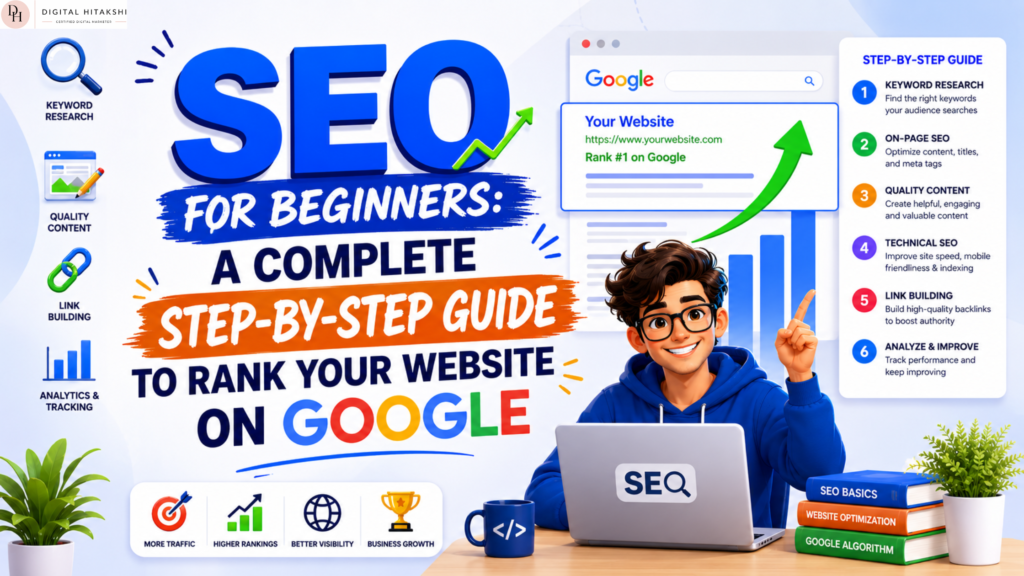
SEO for Beginners: A Complete Step-by-Step Guide to Rank Your Website on Google

SEO for Beginners: A Complete Step-by-Step Guide to Rank Your Website on Google Introduction Building a website is only the beginning of your online journey. The real challenge starts when you want people to discover your website, engage with your content, and become customers. Millions of websites compete every day for visibility on Google, making it important for businesses, bloggers, entrepreneurs, and marketers to understand how search engines work. This is where SEO for Beginners becomes essential. Search Engine Optimization (SEO) is the process of improving your website so that search engines can understand your content and show it to the right audience. Whether you are running a small business website, writing a blog, launching an online store, or building a personal brand, SEO helps you attract organic traffic without depending completely on paid advertising. Many beginners think SEO is complicated because it involves technical terms, algorithms, and continuous updates. However, with the right approach, anyone can learn SEO step by step. In this complete Search Engine Optimization guide, Digi Hitakshi Shinde explains the fundamentals of SEO, Google ranking factors, keyword research, content optimization, technical SEO basics, and practical SEO strategies for beginners to improve website visibility. By the end of this guide, you will understand how to build a strong SEO foundation and create a website that has better chances of ranking on Google. What is SEO? SEO stands for Search Engine Optimization. It is the practice of optimizing your website, content, and online presence to improve visibility in search engine results pages (SERPs). When someone searches for information on Google, the search engine analyzes thousands of websites and displays the most relevant results. SEO helps your website communicate with Google so that your pages can appear when users search for related topics. For example: Imagine you own a digital marketing agency in Mumbai. A potential customer searches: “Best digital marketing consultant near me” If your website is properly optimized for SEO, Google may show your website among the top results. Without SEO, even an excellent website may remain invisible. How Search Engines Work Search engines like Google follow three major processes: 1. Crawling Search engines use automated bots, also called crawlers or spiders, to discover new and updated website pages. 2. Indexing After discovering a page, Google analyzes the content and stores information about it in its database. 3. Ranking When a user searches for something, Google ranks indexed pages based on relevance, quality, authority, and user experience. The goal of SEO is to help search engines understand your website better and improve your ranking opportunities. Organic Traffic vs Paid Traffic There are two major ways websites receive visitors: Paid Traffic Paid traffic comes from advertisements. Businesses pay platforms like Google Ads or social media platforms to display their content. Advantages: Limitations: Organic Traffic Organic traffic comes naturally from search engines. Advantages: SEO focuses on increasing organic traffic by improving website quality and relevance. Why SEO is Important for Your Website SEO is no longer optional for businesses that want sustainable online growth. A strong SEO strategy helps your website attract the right audience and create valuable business opportunities. 1. Increase Organic Website Traffic The majority of online experiences begin with a search engine. When your website ranks for relevant keywords, potential customers can discover your brand naturally. For example: A blogger writing about “healthy breakfast recipes” can attract thousands of visitors by ranking for relevant search terms. 2. Build Brand Authority Websites appearing consistently on Google often gain more trust from users. High-quality content combined with effective SEO helps establish your brand as an expert in your industry. For Digi Hitakshi Shinde, publishing detailed digital marketing resources can help build authority around SEO, content marketing, and online growth. 3. Generate Quality Leads SEO does not only bring traffic; it brings targeted traffic. People searching for specific solutions already have interest or intent. For example: Someone searching “SEO services for small business” is more likely to need SEO assistance compared to someone casually browsing. 4. Reduce Dependence on Paid Advertising Advertising can generate quick results, but SEO creates a long-term digital asset. A well-optimized blog article can continue bringing visitors months or years after publication. 5. Support Long-Term Business Growth SEO improves multiple areas of your online presence: This makes SEO one of the most valuable digital marketing investments. How Google Ranking Works Understanding Google ranking factors helps beginners create better SEO strategies. Google’s primary goal is simple: Provide the most useful answer to users. To achieve this, Google evaluates multiple factors. Important Google Ranking Factors 1. Content Quality High-quality content is one of the strongest ranking signals. Your content should: A 1000-word article that genuinely helps readers can outperform a 3000-word article filled with unnecessary information. 2. Search Intent Search intent means understanding why someone searches for something. Common search intents include: Informational Intent Users want information. Example:“What is SEO?” Commercial Intent Users compare options before buying. Example:“Best SEO tools for beginners” Transactional Intent Users want to take action. Example:“Hire SEO expert” Creating content based on search intent improves ranking potential. 3. Website Authority Authority represents how trustworthy your website appears. Factors affecting authority include: 4. User Experience Google prefers websites that provide a positive experience. Important elements: 5. Website Speed Slow websites negatively impact user experience. Improve speed by: 6. Mobile Optimization Most users access websites through smartphones. A mobile-friendly website should: Complete SEO Process Step-by-Step Now, let’s understand how beginners can implement SEO effectively. Step 1: Keyword Research Keyword research is the foundation of SEO. Keywords are the words and phrases users type into search engines. Example: A person searching: “how to learn SEO” is looking for educational content. A business targeting: “SEO consultant in Mumbai” is targeting customers. Understanding Search Intent Before selecting keywords, understand what users want. Ask: Short-Tail vs Long-Tail Keywords Short-Tail Keywords Examples: These have high competition. Long-Tail Keywords Examples: These are more specific and easier to target. Keyword Research Tools Useful tools include: Beginners should focus on keywords with:

SEO for Beginners: A Complete Step-by-Step Guide to Rank Your Website on Google Read More »

Top Digital Marketing Trends in 2026 Every Business Must Know

Top Digital Marketing Trends in 2026 Every Business Must Know Digital marketing is evolving faster than ever before. Strategies that worked just two years ago are already becoming outdated. In 2026, businesses are entering a new era where artificial intelligence, conversational experiences, personalized marketing, and human-centered branding are shaping the future of online growth. Consumers today expect brands to understand their needs instantly. They want personalized recommendations, fast communication, authentic content, and seamless experiences across every platform. Businesses that fail to adapt to these changing expectations risk losing visibility, traffic, and customers. This is exactly why understanding the latest digital marketing trends in 2026 is no longer optional. Whether you are a startup founder, freelancer, marketer, or business owner, staying updated with modern marketing strategies can help you remain competitive in a rapidly evolving digital world. In this detailed guide, we will explore the most important digital marketing trends shaping 2026 and how businesses can use them to increase visibility, improve engagement, and drive long-term growth. 1. AI-Powered Marketing Automation is Becoming Smarter Artificial intelligence is no longer just a trend. It is becoming the foundation of modern digital marketing. Businesses are now using AI-powered tools to automate customer interactions, analyze behavior patterns, generate content, optimize ad campaigns, and improve customer experiences. AI marketing automation helps brands: For example, e-commerce brands now use predictive analytics to recommend products based on browsing behavior. Similarly, AI chatbots can answer customer queries instantly without human support. Popular AI marketing tools in 2026 include: One of the biggest benefits of AI-powered marketing is personalization. Customers today expect tailored experiences. AI helps businesses deliver personalized emails, advertisements, and recommendations based on user behavior. Businesses that embrace AI early will gain a major competitive advantage in the future of digital marketing. 2. GEO and AI SEO Are Changing Search Marketing Traditional SEO is evolving rapidly. In 2026, Generative Engine Optimization (GEO) and AI SEO are becoming essential for online visibility. Search engines are increasingly powered by AI-generated answers instead of traditional blue-link results. Platforms like ChatGPT, Google SGE, Gemini, and Perplexity AI are transforming how users discover information online. This shift means businesses must optimize content not only for Google rankings but also for AI-generated responses. Key GEO optimization strategies include: The future of SEO is no longer just keyword optimization. It is about becoming the most trustworthy and helpful source of information. Brands that focus on quality, expertise, and semantic SEO will dominate AI search visibility in the coming years. 3. Short-Form Video Content Will Continue to Dominate Short-form video is one of the biggest digital marketing trends in 2026. Platforms like Instagram Reels, YouTube Shorts, and TikTok-style videos are capturing audience attention faster than traditional content formats. People now prefer: Short-form videos perform exceptionally well because they are easy to consume, highly engaging, and algorithm-friendly. Businesses can use short-form video marketing to: In 2026, authenticity matters more than perfection. Users connect with relatable and genuine content instead of overproduced advertisements. A simple 30-second educational video can often outperform a professionally produced commercial. 4. Voice Search Optimization is Growing Rapidly Voice search is becoming increasingly important as smart devices become more common in homes and workplaces. People now use voice assistants like: Instead of typing short keywords, users ask conversational questions like: This change is influencing how content should be optimized. Voice search optimization strategies include: Businesses that optimize for voice search can improve visibility in mobile and smart-device searches. 5. WhatsApp Marketing is Becoming a Powerful Sales Channel WhatsApp marketing is transforming customer communication, especially in India. Businesses now use WhatsApp Business for: Consumers prefer direct communication instead of waiting for email responses. WhatsApp marketing offers: Automation tools also allow businesses to create chatbot-driven customer journeys directly on WhatsApp. For small businesses, WhatsApp marketing is becoming one of the most cost-effective digital marketing channels in 2026. 6. Personal Branding is the New Business Strategy People trust people more than logos. This is why personal branding is becoming one of the strongest marketing trends in 2026. Founders, marketers, consultants, and creators are building audiences through: Personal branding helps businesses: Consumers are more likely to buy from brands they recognize and trust. Founder-led content is now outperforming traditional corporate marketing because audiences connect with authenticity and real experiences. 7. First-Party Data and Privacy Marketing Matter More Than Ever With increasing privacy regulations and the decline of third-party cookies, businesses are shifting toward first-party data collection. This means brands must build direct relationships with their audiences. Businesses can collect first-party data through: Transparency and trust are becoming critical in digital marketing. Consumers want to know: Ethical marketing practices will become a major competitive advantage. 8. Influencer and Micro-Influencer Marketing Continues to Grow Influencer marketing is evolving beyond celebrity endorsements. Micro-influencers are becoming highly effective because they have: Brands are now partnering with smaller creators who have loyal communities instead of chasing massive follower counts. This approach often generates better ROI and more meaningful customer engagement. Authenticity is becoming the driving force behind successful influencer campaigns. 9. Omnichannel Marketing Creates Better Customer Experiences Modern consumers interact with brands across multiple platforms. A customer may: This is why omnichannel marketing is essential in 2026. Businesses must create consistent experiences across: Consistency improves trust, user experience, and conversion rates. 10. Human-Centered Content Marketing is Winning AI-generated content is everywhere, but human-centered content stands out. Google’s EEAT guidelines emphasize: Businesses that publish authentic, experience-driven, and valuable content will continue to rank higher. Human storytelling, original insights, and real experiences are becoming essential for content marketing success. The future of content marketing is not just AI-generated content. It is meaningful, audience-focused communication. Future of Digital Marketing Beyond 2026 The future of digital marketing will become even more personalized, intelligent, and immersive. Emerging trends include: However, despite technological advancements, human trust and authenticity will remain the core of successful marketing. Businesses that combine AI efficiency with human creativity will dominate the next decade. How Businesses Can Prepare for Digital Marketing in 2026

Top Digital Marketing Trends in 2026 Every Business Must Know Read More »