
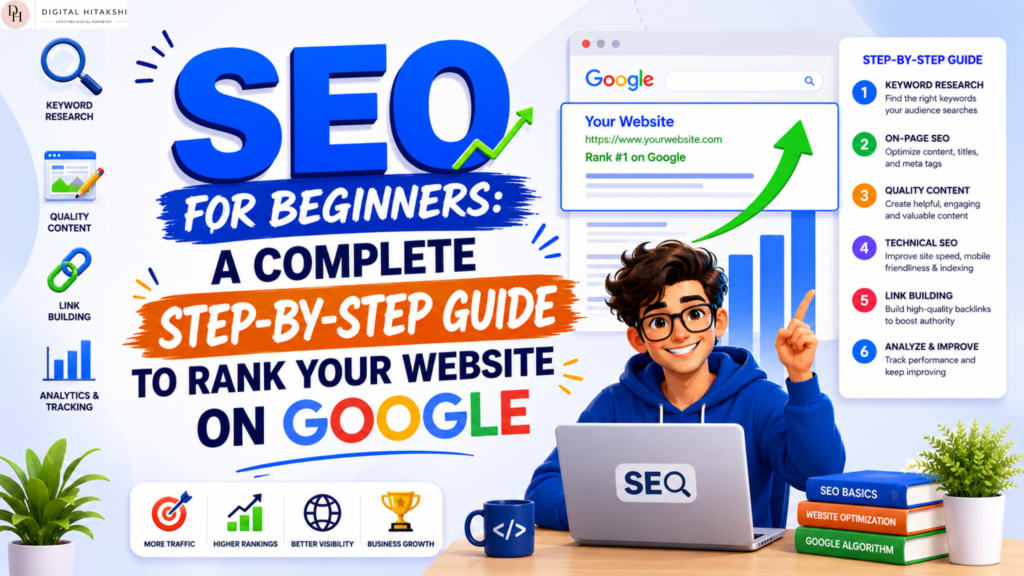
SEO for Beginners: A Complete Step-by-Step Guide to Rank Your Website on Google
Introduction
Building a website is only the beginning of your online journey. The real challenge starts when you want people to discover your website, engage with your content, and become customers. Millions of websites compete every day for visibility on Google, making it important for businesses, bloggers, entrepreneurs, and marketers to understand how search engines work.
This is where SEO for Beginners becomes essential.
Search Engine Optimization (SEO) is the process of improving your website so that search engines can understand your content and show it to the right audience. Whether you are running a small business website, writing a blog, launching an online store, or building a personal brand, SEO helps you attract organic traffic without depending completely on paid advertising.
Many beginners think SEO is complicated because it involves technical terms, algorithms, and continuous updates. However, with the right approach, anyone can learn SEO step by step.
In this complete Search Engine Optimization guide, Digi Hitakshi Shinde explains the fundamentals of SEO, Google ranking factors, keyword research, content optimization, technical SEO basics, and practical SEO strategies for beginners to improve website visibility.
By the end of this guide, you will understand how to build a strong SEO foundation and create a website that has better chances of ranking on Google.
What is SEO?
SEO stands for Search Engine Optimization. It is the practice of optimizing your website, content, and online presence to improve visibility in search engine results pages (SERPs).
When someone searches for information on Google, the search engine analyzes thousands of websites and displays the most relevant results. SEO helps your website communicate with Google so that your pages can appear when users search for related topics.
For example:
Imagine you own a digital marketing agency in Mumbai. A potential customer searches:
“Best digital marketing consultant near me”
If your website is properly optimized for SEO, Google may show your website among the top results.
Without SEO, even an excellent website may remain invisible.
How Search Engines Work
Search engines like Google follow three major processes:
1. Crawling
Search engines use automated bots, also called crawlers or spiders, to discover new and updated website pages.
2. Indexing
After discovering a page, Google analyzes the content and stores information about it in its database.
3. Ranking
When a user searches for something, Google ranks indexed pages based on relevance, quality, authority, and user experience.
The goal of SEO is to help search engines understand your website better and improve your ranking opportunities.
Organic Traffic vs Paid Traffic
There are two major ways websites receive visitors:
Paid Traffic
Paid traffic comes from advertisements. Businesses pay platforms like Google Ads or social media platforms to display their content.
Advantages:
- Immediate visibility
- Quick traffic generation
- Useful for promotions
Limitations:
- Requires continuous investment
- Traffic stops when advertising stops
Organic Traffic
Organic traffic comes naturally from search engines.
Advantages:
- Long-term results
- Builds credibility
- Cost-effective growth
SEO focuses on increasing organic traffic by improving website quality and relevance.
Why SEO is Important for Your Website
SEO is no longer optional for businesses that want sustainable online growth. A strong SEO strategy helps your website attract the right audience and create valuable business opportunities.
1. Increase Organic Website Traffic
The majority of online experiences begin with a search engine. When your website ranks for relevant keywords, potential customers can discover your brand naturally.
For example:
A blogger writing about “healthy breakfast recipes” can attract thousands of visitors by ranking for relevant search terms.
2. Build Brand Authority
Websites appearing consistently on Google often gain more trust from users.
High-quality content combined with effective SEO helps establish your brand as an expert in your industry.
For Digi Hitakshi Shinde, publishing detailed digital marketing resources can help build authority around SEO, content marketing, and online growth.
3. Generate Quality Leads
SEO does not only bring traffic; it brings targeted traffic.
People searching for specific solutions already have interest or intent.
For example:
Someone searching “SEO services for small business” is more likely to need SEO assistance compared to someone casually browsing.
4. Reduce Dependence on Paid Advertising
Advertising can generate quick results, but SEO creates a long-term digital asset.
A well-optimized blog article can continue bringing visitors months or years after publication.
5. Support Long-Term Business Growth
SEO improves multiple areas of your online presence:
- Website visibility
- Brand awareness
- Customer trust
- Lead generation
- Online reputation
This makes SEO one of the most valuable digital marketing investments.
How Google Ranking Works
Understanding Google ranking factors helps beginners create better SEO strategies.
Google’s primary goal is simple:
Provide the most useful answer to users.
To achieve this, Google evaluates multiple factors.
Important Google Ranking Factors
1. Content Quality
High-quality content is one of the strongest ranking signals.
Your content should:
- Answer user questions
- Provide accurate information
- Offer practical solutions
- Be easy to understand
- Demonstrate expertise
A 1000-word article that genuinely helps readers can outperform a 3000-word article filled with unnecessary information.
2. Search Intent
Search intent means understanding why someone searches for something.
Common search intents include:
Informational Intent
Users want information.
Example:
“What is SEO?”
Commercial Intent
Users compare options before buying.
Example:
“Best SEO tools for beginners”
Transactional Intent
Users want to take action.
Example:
“Hire SEO expert”
Creating content based on search intent improves ranking potential.
3. Website Authority
Authority represents how trustworthy your website appears.
Factors affecting authority include:
- Quality backlinks
- Expert content
- Brand mentions
- Consistent publishing
4. User Experience
Google prefers websites that provide a positive experience.
Important elements:
- Easy navigation
- Fast loading speed
- Mobile-friendly design
- Clear content structure
5. Website Speed
Slow websites negatively impact user experience.
Improve speed by:
- Compressing images
- Using reliable hosting
- Removing unnecessary plugins
- Optimizing website code
6. Mobile Optimization
Most users access websites through smartphones.
A mobile-friendly website should:
- Adjust automatically to screen size
- Have readable text
- Provide easy navigation
Complete SEO Process Step-by-Step
Now, let’s understand how beginners can implement SEO effectively.
Step 1: Keyword Research
Keyword research is the foundation of SEO.
Keywords are the words and phrases users type into search engines.
Example:
A person searching:
“how to learn SEO”
is looking for educational content.
A business targeting:
“SEO consultant in Mumbai”
is targeting customers.
Understanding Search Intent
Before selecting keywords, understand what users want.
Ask:
- Are they looking for information?
- Are they comparing products?
- Are they ready to buy?
Short-Tail vs Long-Tail Keywords
Short-Tail Keywords
Examples:
- SEO
- Marketing
- Website
These have high competition.
Long-Tail Keywords
Examples:
- SEO tips for small businesses
- How beginners can learn SEO
These are more specific and easier to target.
Keyword Research Tools
Useful tools include:
- Google Keyword Planner
- Google Trends
- Semrush
- Ahrefs
- Ubersuggest
Beginners should focus on keywords with:
- Good search relevance
- Lower competition
- Clear user intent
Step 2: Create High-Quality SEO Content
Content is the foundation of successful SEO.
Google rewards content that provides genuine value.
A strong SEO content strategy includes:
Solve User Problems
Before writing content, ask:
“What problem is my audience trying to solve?”
Follow E-E-A-T Principles
Google emphasizes:
Experience
Show practical knowledge.
Expertise
Provide accurate information.
Authoritativeness
Build credibility.
Trustworthiness
Create reliable content.
Create Structured Content
A good SEO article should include:
- Clear introduction
- Proper headings
- Short paragraphs
- Examples
- FAQs
- Actionable tips
Step 3: Master On-Page SEO
On-page SEO refers to optimizing elements within your website.
SEO Title Optimization
Your title should:
- Include target keyword
- Be attractive
- Encourage clicks
Example:
SEO for Beginners: Step-by-Step Guide to Rank on Google
Meta Description
A meta description summarizes your page.
It should:
- Include keywords naturally
- Explain value
- Encourage users to click
URL Structure
Create simple URLs.
Good:
example.com/seo-for-beginners
Avoid:
example.com/page?id=12345
Heading Optimization
Use:
H1 → Main title
H2 → Major sections
H3 → Supporting topics
This improves readability and SEO structure.
Internal Linking
Internal links connect related pages.
Example:
A blog about SEO can link to:
- Digital Marketing Guide
- Content Marketing Guide
- Google Ads Guide
This improves navigation and helps search engines understand your website structure.
Image Optimization
Optimize images by:
- Reducing file size
- Adding descriptive file names
- Using alt text
Step 4: Technical SEO Basics
Technical SEO improves website performance and search engine accessibility.
Important areas include:
Website Speed
Fast websites improve user experience.
HTTPS Security
Secure websites use HTTPS encryption.
XML Sitemap
A sitemap helps search engines discover website pages.
Robots.txt
This file provides instructions to search engine crawlers.
Crawlability and Indexing
Ensure Google can properly access and index your pages.
Step 5: Build Authority With Off-Page SEO
Off-page SEO focuses on activities outside your website.
Backlinks
Backlinks are links from other websites pointing to your website.
Quality matters more than quantity.
One backlink from a trusted website can be more valuable than many low-quality links.
Effective Off-Page SEO Strategies
- Guest blogging
- Digital PR
- Industry partnerships
- Brand mentions
- Community engagement
6. SEO Checklist for Beginners
Use this website SEO checklist:
☐ Keyword research completed
☐ SEO-friendly title created
☐ Meta description optimized
☐ Content provides value
☐ Proper headings used
☐ Internal links added
☐ Images optimized
☐ Website speed checked
☐ Mobile-friendly design
☐ Backlinks developed
☐ Performance monitored
7. Common SEO Mistakes Beginners Should Avoid
Keyword Stuffing
Using keywords excessively makes content unnatural.
Focus on helping readers first.
Copying Content
Duplicate content provides little value.
Always create original insights.
Ignoring Technical SEO
Great content cannot perform well if Google cannot access your website properly.
Buying Spam Backlinks
Low-quality backlinks can damage website reputation.
Not Tracking Results
SEO requires measurement.
Track:
- Rankings
- Traffic
- Clicks
- User behavior
8. Best SEO Tools for Beginners
Google Search Console
Helps monitor:
- Search performance
- Indexing issues
- Keyword rankings
Google Analytics
Tracks:
- Website visitors
- User behavior
- Conversions
Google Keyword Planner
Useful for keyword research.
Google Trends
Shows search popularity trends.
Semrush
Provides SEO research and competitor analysis.
Ahrefs
Useful for backlink analysis.
Ubersuggest
Beginner-friendly keyword research tool.
9. How SEO Fits Into Digital Marketing Strategy
SEO works best when combined with other digital marketing activities.
A complete digital marketing strategy includes:
SEO Guide
Improves organic visibility.
Social Media Marketing Guide
Builds audience engagement and brand awareness.
Google Ads Guide
Generates immediate targeted traffic.
Content Marketing Guide
Creates valuable resources for users.
Email Marketing Guide
Builds customer relationships.
Together, these channels create a powerful digital growth ecosystem.
SEO acts as the foundation because it creates sustainable visibility.
10. Future of SEO
SEO continues to evolve with technology.
Future SEO trends include:
AI-Powered Search
Artificial intelligence is changing how users discover information.
Brands must focus on helpful, expert-driven content.
Voice Search
More people are using voice assistants to search.
Content should answer conversational questions.
User Experience Optimization
Google increasingly focuses on:
- Speed
- Accessibility
- Engagement
- Satisfaction
Search Intent Optimization
Future SEO success will depend less on keyword repetition and more on understanding user needs.
Conclusion
SEO is one of the most valuable skills for anyone building an online presence. Whether you are a student, blogger, entrepreneur, freelancer, or business owner, understanding SEO helps you create better visibility and attract the right audience.
Learning SEO for Beginners is not about finding shortcuts. It requires consistency, testing, learning, and adapting to changes in search algorithms.
A successful SEO strategy combines:
- Quality content
- Proper keyword research
- Technical optimization
- User-focused experience
- Authority building
When implemented correctly, SEO becomes a long-term investment that continues generating opportunities.
Digi Hitakshi Shinde helps beginners and businesses understand digital marketing through practical strategies, SEO insights, and actionable growth techniques.
Follow Digi Hitakshi Shinde for more practical digital marketing guides, SEO tips, and online growth strategies.
6. FAQ Section
What is SEO for beginners?
SEO for beginners means learning the basic techniques required to improve website visibility on search engines like Google. It includes keyword research, content optimization, technical SEO, and link building.
How long does SEO take to show results?
SEO results depend on factors like competition, website quality, content strategy, and consistency. Generally, meaningful improvements may take several months.
Can beginners learn SEO without coding?
Yes. Beginners can learn SEO without programming knowledge. Basic technical understanding helps, but most SEO activities focus on content, keywords, and optimization.
What is the difference between SEO and Google Ads?
SEO generates organic traffic through optimization, while Google Ads provides paid traffic through advertising campaigns.
What are the best SEO strategies for beginners?
Beginners should focus on:
- Keyword research
- Helpful content creation
- On-page SEO
- Technical improvements
- Building quality backlinks
7. Internal Linking Suggestions
Suggested internal links for Digi Hitakshi Shinde:
- Complete Digital Marketing Guide
Anchor Text: “complete digital marketing guide” - Social Media Marketing Guide
Anchor Text: “social media marketing strategies” - Google Ads Guide
Anchor Text: “Google Ads advertising guide” - Content Marketing Guide
Anchor Text: “content marketing strategies” - Email Marketing Guide
Anchor Text: “email marketing for business growth”
8. Social Media Captions
LinkedIn Caption
🚀 Want your website to rank higher on Google?
SEO is not magic — it is a strategic process.
I created a beginner-friendly SEO guide covering:
✅ Keyword research
✅ On-page SEO
✅ Technical SEO
✅ Backlinks
✅ Google ranking strategies
Learn how SEO can help you build long-term online visibility.
#SEO #DigitalMarketing #ContentMarketing
Instagram Caption
Want more people to discover your website? 🔍
SEO helps your business appear when your audience searches online.
From keywords to Google rankings, learn SEO step by step.
Save this guide for your digital growth journey 🚀
#SEOForBeginners #DigitalMarketingTips
9. Featured Image Idea
Image Concept:
A professional digital marketing workspace showing:
- Laptop with Google search results
- SEO analytics dashboard
- Keyword research charts
- Digital growth graph
- Professional marketer analyzing website performance
Text overlay:
“SEO for Beginners: Rank Higher on Google”
Style:
Modern, clean, professional, suitable for a digital marketing blog.
10. CTA
Ready to improve your website visibility and grow online?
Start implementing these SEO strategies today and build a strong digital foundation.
For more beginner-friendly digital marketing tutorials, SEO strategies, and business growth tips:
Visit Digi Hitakshi Shinde: https://digihitakshi.in/
Follow Digi Hitakshi Shinde for practical digital marketing guides, SEO tips, and online growth strategies.